It was so great to be back at the Royal Agricultural Winter Fair again this year. I attended on Thursday November 7, 2019 and was fortunate to return again on the last day November 10.
There are always LOTS of sketchers at the Royal Agricultural Winter Fair
On November 12th, 2015 I sketched at the Royal Agricultural Winter Fair (RAWF) in Toronto. It was a blissful day!
My Sketch of the Royal Champion Pig
(Art journal: watercolour and ink)
"Ninety-five years ago, a cattle farmer from Brooklin, Ont., had an idea to establish the first national agricultural exhibition, showcasing the best in Canadian farming and livestock". (Source: CBC It's More Than Just Animals)
On Nov. 22, 1922, the Royal Agricultural Winter Fair opened for the first time and remains the premier agricultural fair in Canada.
"Back in 1922 when the Royal started, rail cars came from both sides of Canada into this very place to show cattle against one another. It was a unifying factor back in the 1920s," said Peter Hohenadel, the fair's director of agriculture and food. (Source: CBC It's More Than Just Animals)
Memories
The last time I attended the Royal Winter Fair was over twenty years ago when my children were toddlers and we had a chance to say goodbye to Ian Millar's Big Ben on his 1994 Retirement tour.
The last time I attended the Royal Winter Fair was 1994 Big Ben's Retirement Tour: A picture of me holding my daughter Meagan with Big Ben
(Note on full circle moment of sorts: I was able to see Ian Millar again on this visit. I witnessed his horse having a bad refusal in the show jumping ring and then I watched Ian working things out in the practice ring later)
I grew up attending the Royal Winter Fair. As a student in the GTA/Mississauga areas, we attended the RAWF every year with our schools to learn about agriculture; as an art student, we went to spend the day sketching.
The Royal Winter Fair still forms part of the official curriculum for a number of high schools and art schools in Ontario.
It's no surprise that sketching at the RAWF is part of Sheridan's animation course curriculum (Source: Sheridan course outlines). A lot of the links at the bottom of this page take you to blogs and tumblrs of animation student's sketches at the RAWF.
Following my school years, I continued to attend the RAWF because of my life-long passion for horses (and all things equestrian) and my love of sketching.
The RAWF is the largest agricultural fair in the world and it takes place in the heart of a major metropolis!! Such a wonderful place for artists!
On the day that I was there, there were folks sketching everywhere! It was wonderful!
I spent seven hours at the RAWF sketching and I barely covered it all. Due to my last minute scheduling of this quick trip, I missed the chickens and geese, the beef cows, the goats and the rabbits (see below)........I could have easily gone for another day and I will plan better for next year!
Source: Globe and Mail 2012
Jungho Chan,a first-year animation student Sheridan College does some sketching in the poultry, waterfowl and pigeon display at the Royal Agricultural Winter Fair in Toronto on Nov 7, 2012. The fair celebrated its 90th anniversary in 2012
I was quite sad to have missed the poultry, waterfowl and pigeon. It was one of the areas that I was most excited to sketch this year. The Royal welcomed over 800 chickens, geese, turkeys, pigeons and many more, but they had been restricted to two days only (Nov 10 & 11) at the Royal Winter Fair and I had missed them by one day. I wondered whether the Royal Winter Fair and other large shows are cutting poultry exhibitions from their roster for the year due to concerns over avian influenza contamination?
Some of My Sketches
Here are a few of my sketches that I did on site at the Royal Winter Fair on November 12, 2015.
I took lots of photos as well and plan to use them as references for future sketches that I will blog about in a separate post.
My first cow sketch of the day
I could have spent the entire day sketching cows. I love them so much!
These two watched me the entire time that I was sketching.
It was awesome.
"Bud" the Belgian - one of the first horses that I sketched
Bud preferred to eat his hay rather than pose for me despite my many attention-seeking noises
The exhibition is accompanied by the e-publication Female Self-Representation and the Public Trust: Mary E. Wrinch and the AGW Collection, authored by Dr. Catharine M. Mastin, supplied in downloadable PDF format here.
I love learning about women artists and I am particularly drawn to women who are referred to as "atypical for their generation". Mary Evelyn was certainly that.
She postponed marriage until almost in her fifties and, when she did marry, she married an artist and she enjoyed a positive painting partnership with her husband. (She insisted on being known as M.E. Wrinch and not Mrs.Reid, as she was often referred)
Mary E. Wrinch
(photo source: National Gallery)
Above is the only picture that I could find of her (at the National Gallery). I wondered if she disliked having her photo taken? She certainly appears to be unhappy having this one taken.
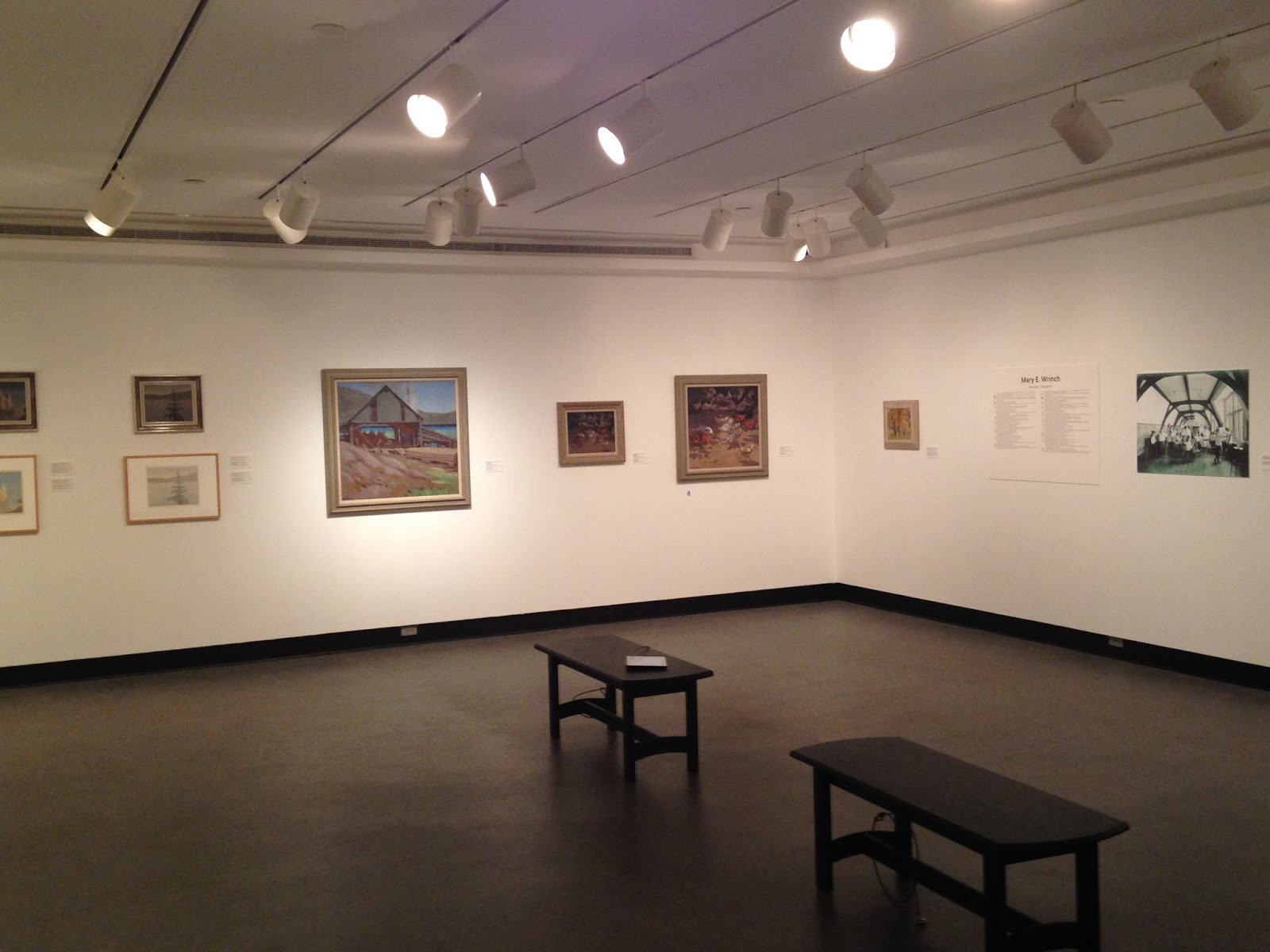
I set off to the Ottawa Art Gallery to see some of her work and learn more about her.
Ottawa Art Gallery
Mary Evelyn (Reid) Wrinch was active and lived in Ontario, Canada. Mary Wrinch is known for her painting, miniatures, and printmaking. At the Art Gallery of Ottawa I was able to see two examples of her miniatures on ivory and they were stunning in their small size and detail!
Miniature on Ivory
Artist, Educator & Property Owner (an atypical woman for her generation)
Mary "was an important artist working in Toronto during the first half of the twentieth century. As a single woman she earned her living as an art educator, presiding over the art department at Bishop Strachan School, Toronto where she worked from 1901 to 1936. Prior to the Group of Seven’s interest in Ontario’s northern landscapes, Wrinch was an outdoor enthusiast and owned a two storey cottage at Kingwood, Lake of Bays, where she canoed and sketched." (Source: OAG)
"Somehow our Canadian landscapes
call for a big canvas and
for direct, out of door painting.
When you do it small,
you lose much of its very essence."
"In 1906, Wrinch's visits to a friend's cottage on Lake Muskoka amid the rivers, lakes, and forested landscape north of Toronto, inspired a radical change in her art. Without preliminary sketches, she now painted directly from nature on canvases over a metre high and wide. At the 1907 OSA exhibition, she showed Sawmill, Muskoka, which was subsequently purchased by the Government of Ontario. Interviewed about her painting in the Toronto Star in 1913, she said, "Somehow our Canadian landscapes call for a big canvas and for direct, out of door painting. When you do it small, you lose much of its very essence." Expanding the techniques used for miniature painting, Wrinch continued to juxtapose colours, rather than blending them, endowing her compositions with an energetic vitality." (Source: CHIN)
At the Ottawa art gallery I loved this painting (below). I love the palette that she used for this one and "The Sawmill"
"In 1922, at 45 years of age, Wrinch married her former teacher, George A. Reid. The two traveled Northern Ontario, Quebec, and Nova Scotia on painting trips.
In 1928, at the age of 51, Wrinch's style changed again. She began experimenting with linoleum block printing, interpreting the landscapes of her paintings into intricate prints that featured rich colours and strong outlines. She was also very interested in studying flowers and many of the prints feature flowers from her own garden." (Source: McNaught Gallery Newsletter June 2014)
I had not seen this linoblock print (below) before and I must say it is my favorite. I have often thought, when I am out plein air painting, how much the landscape lends itself beautifully to the linoleum block. And in this one, Mary has captured the landcape beautifully.
"The Stream" by M.E. Wrinch
More Images of M.E. Wrinch's art
(from around the web)